Neighborhood Institutions;
A Missed Opportunity in Seattle’s Low Rise Zones
Seattle’s Comprehensive plan, adopted in 2025, came with a number of zoning changes designed to increase opportunities for housing and to encourage livable communities. Unfortunately, one of the most critical elements of a growing community was left off the table: Institutions. These are the community centers where our children play basketball, teens get after school help, seniors receive the care and support they need, and our creative arts are shared.
Despite their importance, institutions in Low Rise zones received zero code changes in the Comprehensive plan and in fact the zoning laws around institutions in LR zones have remained unchanged since 1994 despite the growth of our city.
This gap is especially impactful in Seattle’s South End, home to many historically Black and minority communities. Due to their longstanding inequities, these neighborhoods rely heavily on small institutions, often located in LR zones, to serve their needs for education, worship, child care, elder care, community gathering and cultural and arts centers. These institutions are doing the work to maintain the health and character of these communities. Limiting their ability to grow and improve due to land use restrictions is detrimental to the community and harmful to the minority groups that rely on them. We believe that a commonsense revision to the code will support both cultural and economic growth in the south end.
In this blog entry, we highlight several of the unchanged restrictions that most significantly impact these institutions, particularly within LR zones. Our goal is to demonstrate how these regulations limit the ability of community institutions to grow and serve, and to raise awareness of an overlooked issue that affects our city’s path toward more community-centered development, especially in this fast-growing city.
Key Institutional Restrictions:
Setbacks
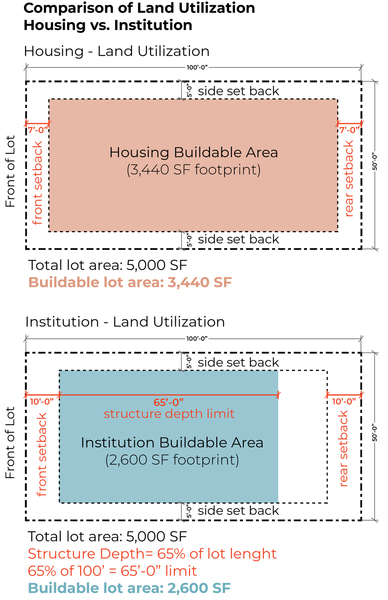
Under SMC 23.45.570.F, institutions have more stringent setbacks than residential in LR zones. The
front and rear setbacks for institutions is 10 feet.
Per Table A for 23.45.518, the front and rear setbacks for
residential uses in LR zones is 7 feet. This reduces the buildable area of an institution’s lot by 6 feet total.
Additionally, as the building height increases for an institution, the buildable footprint further decreases, as additional side setbacks are required per SMC Table B for 23.45.507. The combination of more stringent setbacks and restrictions on structure depth significantly limit the buildable lot area for institutions.
Structure Depth
Under SMC 23.45.570.E, institutions are limited to a structure depth of 65% of the lot depth. This is further restricted as the height of the institution increases, per Table B for 23.45.570. It is typically more cost effective for a building to expand outward on the same level than to go up levels. However, institutions are limited from expanding outward by these code sections and are forced to build up, increasing cost.
Dispersion Requirements
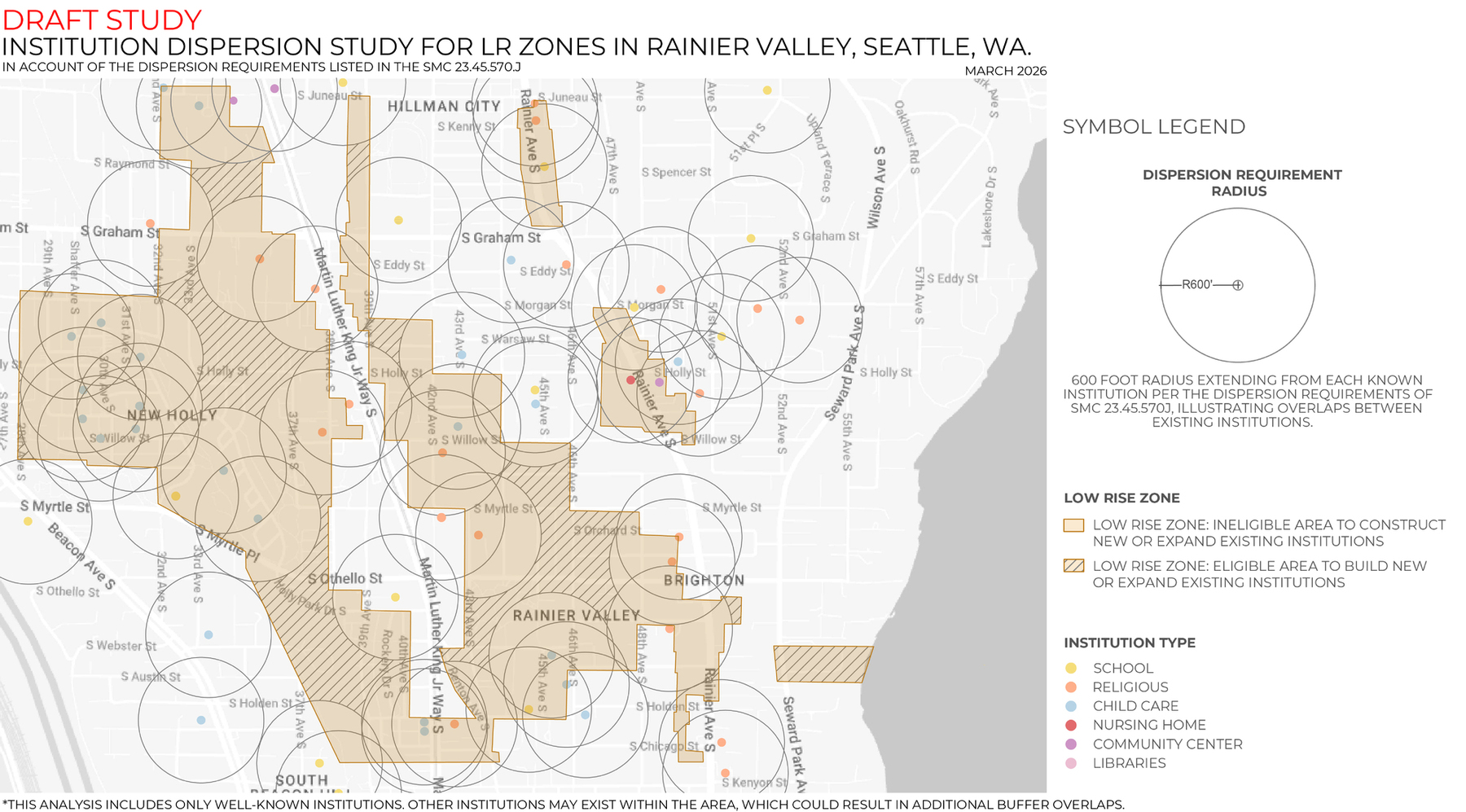
Under SMC 23.45.570.J, any new or expanding institution is not allowed to be within 600 feet of any other institution in a residential zone, except through a limited administrative conditional use. This essentially means that one institution of any size may only be located on every other city block, regardless of size, traffic impact, or type of services offered.
To illustrate this, we studied a section of Rainier Valley where we are currently working on a couple of projects. The diagram below shows existing known institutions and a 600’ radius for the dispersion requirement. We can see that there is almost no way for new institutions to establish themselves and most existing institutions will not be able to expand if needed to serve a growing community. Especially in the South End of Seattle, these institutions are offering essential community services and filling in a fragile social safety net. Phase 2 of the Comprehensive Plan is the right time to address this issue and allow our community partners to help their neighbors.
Other Institutional Restrictions:
Parking
Under SMC 23.45.570.G , institutions are required to provide parking on site. There are no provisions for off-site parking, which is allowed for housing in LR zones. Requiring parking on the site inhibits the usable ground floor that could be dedicated towards the institution. Under the new code, parking is significantly reduced for housing.
Lack of Housing Incentive for Institutions
Combining housing with institutions is a practical and beneficial partnership. The institution provides services to the community, as well as housing for residents of that same community. However, the current code imposes the more stringent “Institutional” land use requirements to the entire building when an institution is located within that building. This significantly limits the amount of housing that would otherwise be able to be provided on the lot. It removes any incentive for the institutions to provide housing, as they do not gain any additional area or buildable footprint to place that housing.